
RESEARCH-BASED AI-FIRST FRAMEWORK

The Open AI-First Framework for Turning Artificial Intelligence into a Sustainable Production Engine

Most organizations are failing to turn AI into real software production capacity — and they don't know why. We do.

Discover why
Webi Framework — Optimal Scope
7×–50×

Production efficiency vs current industry benchmarks.

10×

Code generation effectiveness with high-quality output.

90%+

First-pass success rate in AI-First workflows.

WHY ORGANIZATIONS FAIL WITH AI

The technology is not the problem. The knowledge gap is.

AI adoption reached 90%. Yet incidents per pull request increased 242%. Code churn doubled. The industry is producing more code faster — but not better code. The root cause is not the AI. It is a knowledge gap that most organizations assume AI will compensate for. It won't. AI amplifies what the operator brings — including the gaps.

AI does not create advantage. It amplifies it.
Read the research

THE PARADIGM SHIFT

Everyone claims to be AI-First. Most are operating under the wrong paradigm.

Software development is undergoing a paradigm shift that most organizations have not recognized. The production engine changed from human to machine. This is not an incremental improvement — it is a fundamental change in who produces the artifacts. Most organizations responded by adding AI tools to human-driven processes and calling it AI-First. It is not. It is the old paradigm with more tools on top.

THE FORMAL DEFINITION

AI-First, defined.

A process, system, or organization in which artificial intelligence reliably produces the majority of its artifacts throughout the workflow, with humans serving as guides who provide direction, make decisions, and validate outputs.

This definition is operational. It provides a single criterion: who produces the artifacts. It establishes a spectrum from Human-First through AI-Assisted to AI-First. And it can be applied today to determine where any organization actually stands.

Everything begins with a definition.

Whitepaper №01

Free · No registration required · PDF

Download the paper

A DIFFERENT WAY OF THINKING

AI-First is a Technology, not a set of tools.

Being AI-First isn't just giving a prompt to an agent to generate code, or buying tools for different tasks. It's understanding what is being done and how it is done — a discipline with its own steps, its own context, its own technology.

  1. 01

    The Production Engine changed.

    — Developers no longer write the code. They direct it, evaluate it, and correct the path before errors compound.

  2. 02

    Processes built for human production don't scale to AI speed.

    — When output grows by orders of magnitude, those processes slow down and get overwhelmed by the volume.

  3. 03

    AI amplifies. It doesn't compensate.

    — Strong fundamentals scale into exceptional output. Weak ones scale into disasters.

  4. 04

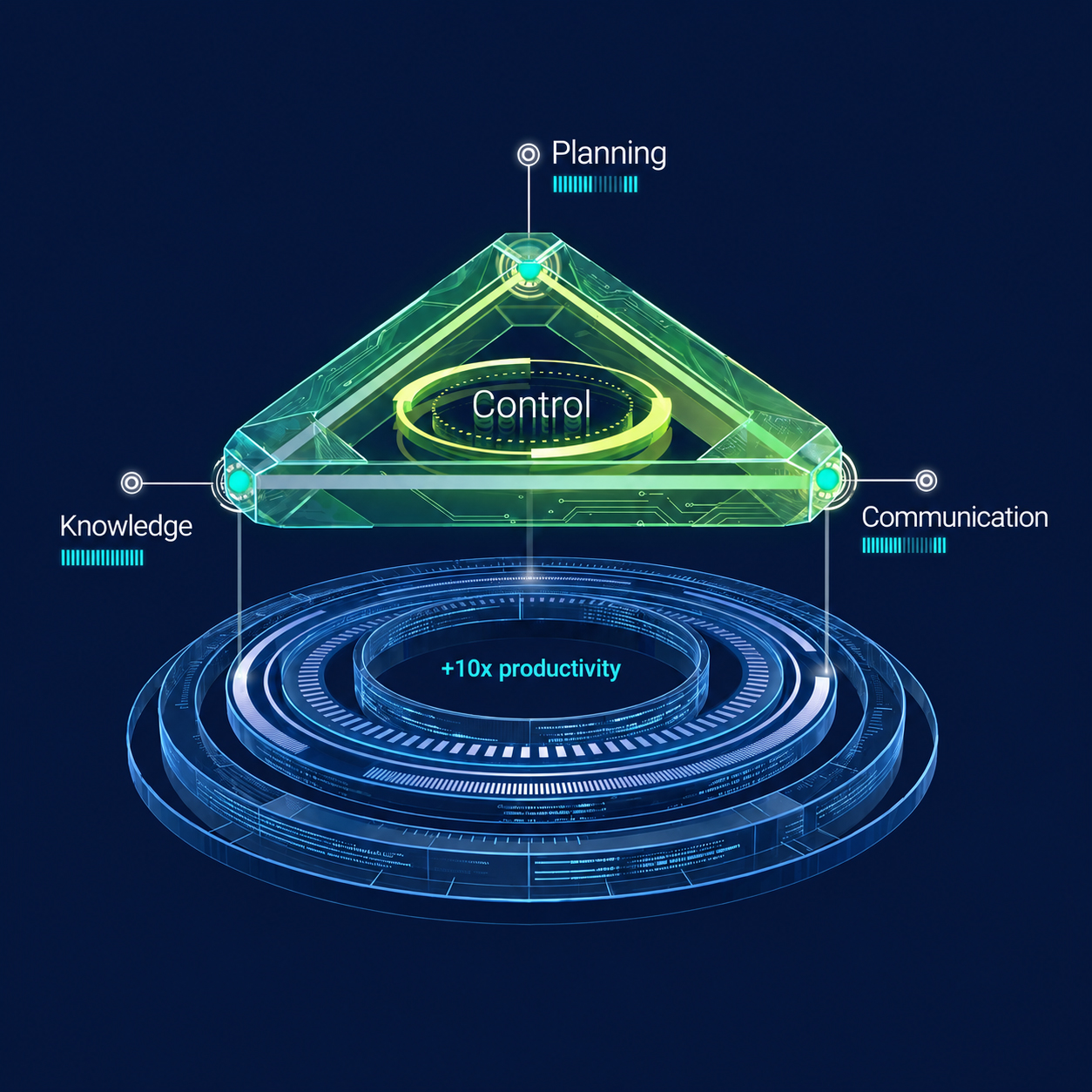
    The Control principle is what determines success.

    — It emerges from knowledge, communication and planning. Without the three, speed just produces risk that looks like progress.

  5. 05

    Knowledge is the hardest gap to close.

    — No amount of better prompting or better tooling bypasses the operator's need to understand how to build quality software.

  6. 06

    Deploying AI tools before the foundation is why most rollouts fail.

    — That foundation is Organizational Readiness: architecture, stack, and knowledge, built before the tooling arrives.

  7. 07

    Closing the gap is an organizational responsibility.

    — Its architecture and stack define the specific knowledge domain that closes the gap, not a generic one.

  8. 08

    The developer must bring strong foundational knowledge.

    — Broad enough to reason across the full stack, closer to what an architect needs than what a traditional coder ever did.

KEY FRAMEWORK INSIGHTS

Five stages to a Sustainable AI-First software production.

Webi Framework is the answer to a problem the market hasn't solved: how to turn AI into a reliable production engine, not just a faster way to write code. It came from applied research, not theory, measuring what actually worked across real projects.

These five stages are the result of that research — the pillars every software organization has to re-architect to get there.

  1. 01

    Foundation

    Architecture, technology stack and the tooling behind them aren't decided once, built in-house or adopted from what already exists. They evolve as the system does, and each refinement has to settle into solid ground before planning, cadence, execution or delivery can build on top of it.

  2. 02

    Planning

    Direction moves through three levels before a single line of code exists — initiatives set the vision, solutions define the path, slices make it executable. Every artifact is created and refined with AI, guided by the professional responsible for it. That route is what the developer follows to direct AI toward a predictable result.

  3. 03

    Cadence

    Traditional Agile measures progress in what a sprint delivers, weeks away. This measures it in what gets delivered today. That shift, from weekly output to daily output, is what keeps the plan aligned with how fast AI actually produces.

  4. 04

    Execution

    A slice runs one to three days, small enough that a developer can genuinely verify what AI produced before moving on. That verification makes the developer the first quality gate — automation checks what follows, because manual testing alone can't keep pace with this volume. Nothing advances until the gate clears.

  5. 05

    Delivery

    Work only advances once it's been checked against everything that already exists, not just what's new. That's what keeps a system built at this speed from coming apart at the seams. The framework's scope ends at that validated point — deployment and production are their own discipline.

The corpus

Four Whitepapers. One Framework.

These whitepapers, grounded in applied research and empirical results, define the principles behind Webi Framework. It isn't a theory waiting to be tested — it's already succeeding in production.

Published·Whitepaper №01

A Formal Definition of AI-First

Establishes the vocabulary, posture and operating logic of an AI-First organization — the ground on which the rest of the corpus stands.

What this whitepaper solves

Provides an operational definition of AI-First — one that can actually be applied to determine where an organization stands, not just an aspiration to point toward.

Download
Free
Published·Whitepaper №02

Capability Distillation Driven Development (CDDD / C3D)

A development methodology that accepts uncertainty as the starting condition of AI work. Intents are distilled through Discovery, Proof of Concept, Intent Maturity Checkpoint and Refinement — only capabilities that earn their place survive.

What this whitepaper solves

Provides a method for developing AI capabilities under uncertainty, and how those same principles apply to software development with AI more broadly.

Download
Free
Published·Whitepaper №03

Closing the Knowledge Gap for AI-First Development

An empirical account of why AI amplifies strong foundations and punishes weak ones — and what a professional, full-stack practice for AI-First development actually requires.

What this whitepaper solves

Explains why strong foundations matter more than advanced technology, and the architecture-to-tooling sequence organizations need to build to close the gap.

Free · Sent by email
Published·Whitepaper №04

PACED: A Framework for AI-First Software Development

An Agile methodology rebuilt from the ground up for AI-First software production — keeping what still works, redesigning what doesn't.

What this whitepaper solves

Diagnoses why traditional Agile can't keep pace with AI-First development, and introduces a solution built for that new paradigm.

Free · Sent by email

MEASURED RESULTS

What we measured while building Webi Framework.

These are some of what got measured during the development and research behind Webi Framework. They point to the kind of productivity potential that's possible when the framework is actually put into practice.

01

3.2%

Self-Churn Rate

Measured daily, at the resolution of individual slices, not sprints. Each slice built on the last instead of rewriting it, which is what made a low churn rate achievable.

THE BASELINE

44% was the churn rate measured in the observed cases without AI-First fundamentals in place.

02

>95%

Code Retained

Code that stayed in production because it followed solid design patterns from the start, not code that merely ran while accumulating antipatterns underneath.

THE BASELINE

Less than 10% is what the same scope produced without those fundamentals in place.

03

8,000 lines/day

Peak Output

Measured at daily resolution, not averaged over a sprint, the resolution that actually captured how output moved day to day.

THE BASELINE

600 lines/day without AI-First fundamentals. 4,500 on the first execution with them. 8,000 at peak, refined.

04

4–8 hours

Planning Efficiency

The time it took to plan an initiative that represented one to five months of team execution.

THE BASELINE

Sprint planning, backlog prep and user stories used to take days under Scrum. This took hours.

Follow Webi Framework

Get notified when something new is published.

Webi Framework evolves through research, observation and real-world implementation. Get notified whenever a new whitepaper is published, an existing one is updated, or a new Insight goes live. A quiet, infrequent communication for leaders, builders and organizations navigating the AI-First era.